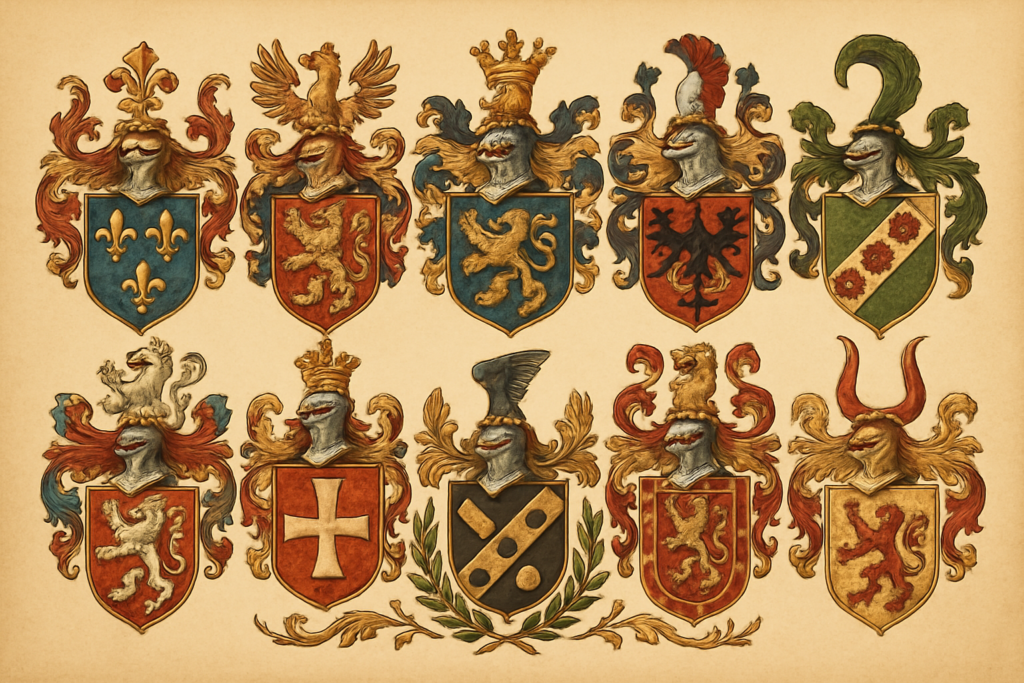
Some coats of arms are so iconic that they’ve shaped how we see entire nations, dynasties, and ideas. From the lions of England to the fleur-de-lis of France, the most famous heraldic designs have influenced art, architecture, flags, and national identity for centuries.
Here are ten of history’s most significant coats of arms — and the stories behind them.
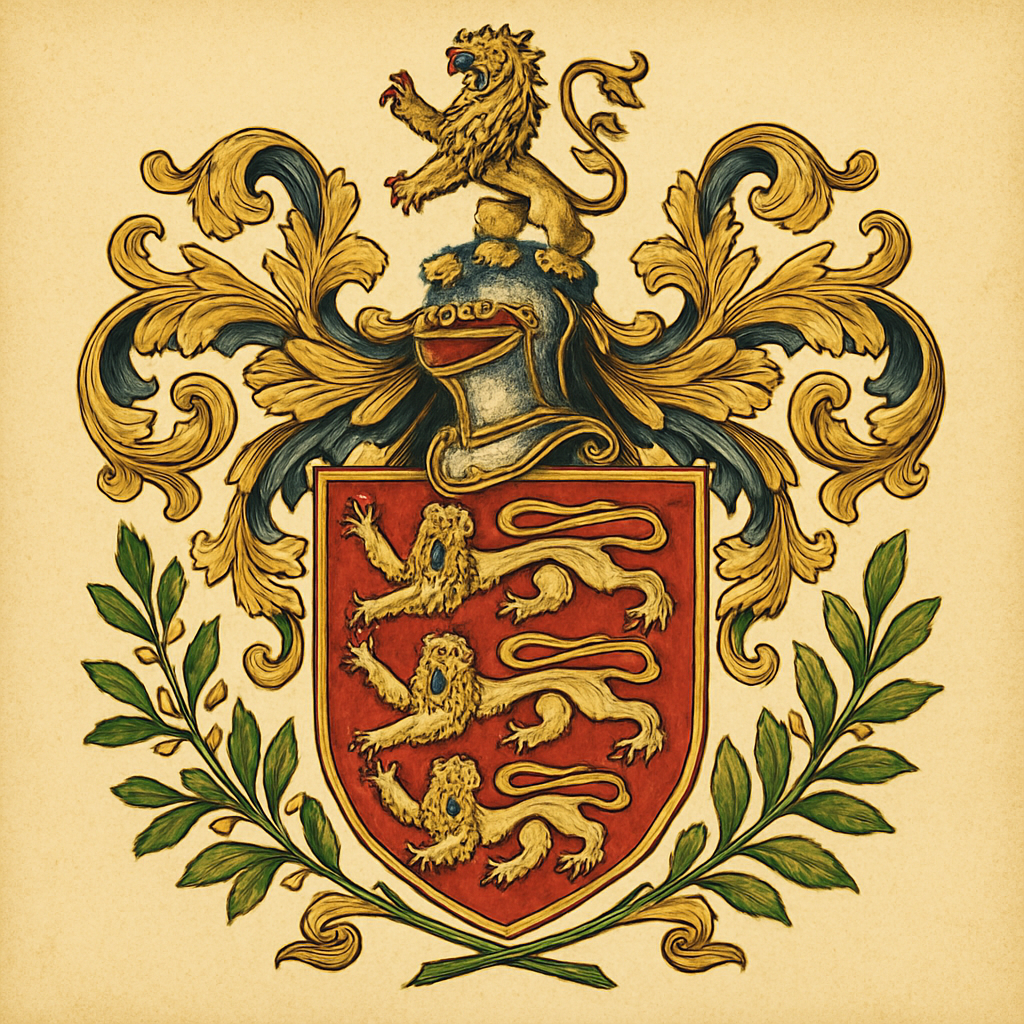
1. The Royal Arms of England
Design: Three gold lions passant gardant on red (Gules, three lions passant guardant or)
The story: The three lions of England are one of the oldest continuously used royal arms in the world, introduced by Richard I (Richard the Lionheart) in the late 12th century. The lion represented courage, strength, and royal majesty. Today, these three lions appear on the arms of the United Kingdom, on the England football shirt, and on countless institutions across the Commonwealth.
What it means: Each lion represents a territory — originally England, Normandy, and Aquitaine. The gold on red creates maximum contrast — visible across any battlefield.
2. The French Royal Arms
Design: Gold fleur-de-lis on blue (originally Azure semée de fleurs-de-lis or — scattered with lilies)
The story: The fleur-de-lis became associated with French royalty by the 12th century. Originally the shield was covered in countless lilies; it was reduced to three in the 14th century by Charles V, symbolizing the Holy Trinity. The blue and gold became the defining colors of French royal identity, spreading to every corner of French culture — from Versailles to the streets of New Orleans.
3. The Habsburg Double-Headed Eagle
Design: A double-headed black eagle on gold, bearing a complex quartered shield
The story: The House of Habsburg ruled much of Europe for six centuries — from Spain to Austria, from Hungary to the Netherlands. Their double-headed eagle (looking both East and West) symbolized dominion over the Holy Roman Empire’s vast territories. The eagle was adopted from Byzantine tradition and became the most feared heraldic symbol in European politics for 400 years.

4. The Medici Balls
Design: Six red balls (torteaux) on gold, in a specific arrangement
The story: The Medici family of Florence — bankers, patrons of the Renaissance, and eventual rulers of Tuscany — used a shield bearing red balls (possibly representing coins or pills, given their early history as pharmacists). These six balls became one of the most recognizable symbols of the Italian Renaissance. They appear carved into buildings across Florence and in artwork from Botticelli to Michelangelo, both of whom worked under Medici patronage.
5. The Scottish Royal Arms
Design: A red lion rampant on gold, within a double border with fleurs-de-lis (Or, a lion rampant gules, double tressure flory counter-flory of the second)
The story: The Lion Rampant of Scotland is one of the most ancient royal emblems in Europe, in use since the 12th century. The elaborate double tressure border (the decorative frame) is unique to Scottish heraldry and traditionally associated with an ancient alliance with France. The Lion Rampant flag remains one of Scotland’s most beloved national symbols.
6. The Papal Arms of the Vatican
Design: Two crossed gold and silver keys on red, surmounted by the papal tiara
The story: The crossed keys represent the Keys of Heaven given by Christ to St. Peter — the gold key for the power to loose, the silver key for the power to bind. These keys have been central to papal heraldry since the Middle Ages and appear on the Vatican flag today. Each pope also has personal arms combined with the institutional crossed keys.
7. The Arms of Castile and León
Design: A golden castle on red (Castile) and a purple lion on silver (León), quartered
The story: The unified arms of Castile and León represent the merger of two of medieval Iberia’s most powerful kingdoms. The castle (castillo) is a visual pun on Castile. The lion represents León (from the Latin leo). Together, these arms became the foundation of the Spanish royal coat of arms and influenced heraldry across Latin America.
8. The Arms of the House of Orange-Nassau
Design: A golden lion rampant on blue, with red tongue and claws, below a blue chief with gold billets (Azure billetty a lion rampant or armed and langued gules)
The story: William of Orange led the Dutch revolt against Spanish rule in the 16th century and became the father of Dutch independence. His family’s arms became synonymous with Protestant liberty and Dutch national identity. The House of Orange later gave England its King William III (William of Orange) in the Glorious Revolution, and the color orange remains associated with the Netherlands today.
9. The Arms of the Holy Roman Empire
Design: A single-headed or double-headed black eagle on gold
The story: The imperial eagle of the Holy Roman Empire — the most complex political entity in medieval Europe — was one of the most powerful heraldic symbols of the Western world for nearly a thousand years. The single eagle was used by Charlemagne; the double-headed version became standard from the 15th century, looking East and West to symbolize the empire’s vast scope. Germany’s modern arms still feature a black eagle on gold, descended from this tradition.
10. The Arms of the O’Neill Earls of Ulster
Design: A red left hand on gold (the Red Hand of Ulster)
The story: According to Irish legend, a boat race was held to determine who would be king of Ulster — whoever touched the shore first would win. One contestant, seeing he was about to lose, cut off his hand and threw it to the shore, winning by a bloody technicality. The Red Hand of Ulster — one of the most ancient heraldic symbols in the British Isles — has been associated with the O’Neill dynasty ever since. It appears today on the flags of Ulster and Northern Ireland.
Your Family’s Place in This History
Every coat of arms on this list began as a personal identity — a specific person’s symbol at a specific moment in history. Yours did too. The difference is that these became famous. Yours is personal.
And personal is often more meaningful.
- Search your family name — discover the coat of arms and origins that belong to your history
- The Family Legacy Report — your family’s coat of arms, surname history, and symbol meanings in one digital PDF, delivered instantly to your email